Web & UI
Daily driverInterfaces, games and visuals for the browser.
- HTML5 Canvas
- Phaser 3
- CSS3
- Webpack
- React
- DOM APIs
- Responsive design
- UI/UX principles
- Adobe Creative Suite
- Canva
Bengaluru, IN · Open to full-time roles
Software Developer — building web interfaces
Python & JavaScript developer (MCA, 2025). I build websites, graphic & game UIs, backend APIs and GenAI services — and I sketch the workflow before I write the code.
I'm Kushar — an MCA graduate and software developer who writes the code, designs the visuals and ships the thing.
Most recently I was an HTML5 Developer Trainee at BR Softech in Jaipur (Feb – May 2026), building Phaser 3 gameplay systems — physics, collision detection, state machines, scoring and multi-level progression — and shipping Tokyo Can Sort, a 20-level puzzle game auto-deployed with GitHub Actions.
Before that I spent six months on the NSDC AI-DevOps Engineer program (SSC/Q8112, NSQF Level 5) with Orbiqe Technologies, building CI/CD pipelines with Jenkins, Ansible, Docker, Terraform and AWS, and delivering HMRS, an HR management system.
Lately I've been building GenAI services — Recall AI gives AI agents long-term memory with Gemini, Mem0 and Qdrant. Across all of it the skills carry over: clean interfaces people enjoy using, and reliable code behind them.
Not just work well.
Most of what I know I learned by building.
Design and code are the same craft.
Broadly applicable across products — from websites and graphical interfaces to APIs, AI services and the pipelines that ship them. Filter by area.
Interfaces, games and visuals for the browser.
Services with clear contracts and tests.
LLM apps, retrieval and classic ML.
Build, test and deploy — automated.
What the work is written in.
The bench around the code.
Bengaluru, India
BR Softech Pvt. Ltd. · Jaipur
Bihar Skill Development Mission & Orbiqe Technologies · Noida
InAmigos Foundation · Remote
Haldia Institute of Technology
Birla Institute of Technology, Mesra · Patna
Ongoing program — DSA, React, backend & REST APIs
Open any project to see the problem, the stack and the step-by-step build: idea → blueprint → assets → build → logic & testing → deploy.
Long-term, per-user memory for AI agents. Conversations become durable, searchable facts via Mem0 and Qdrant; Gemini handles replies and embeddings.
A 20-level colour-sorting puzzle with two modes. Game loop, level state machine and win/fail logic written from scratch; auto-deployed on every push.
A Random Forest predicts disaster type and severity from historical, geographic and time-based data, then estimates impact and recommends recovery steps.
Browser-native Tetris in vanilla JavaScript — piece rotation, line clearing, scoring and game-over detection.
An HR management system delivered through the full DevOps lifecycle — source control, containerisation, CI/CD and deployment.
Multi-stage Docker build — the final image holds only the compiled binary.
Pipeline configs, automation scripts and CI/CD setups from real DevOps work.
Jenkins pipeline testing and CI/CD automation configuration.
SonarQube static analysis integrated with a Node.js project.
Python microservice architecture — modular, containerised services.
Python scripts exploring Git workflows, automation and branching strategies.
A JavaScript mechanics experiment — where the game-dev journey started.
Before touching an editor I sketch the whole workflow on a canvas. Once I can see every box and arrow, the code is mostly translation.
Map the whole system on a tldraw canvas — actors, screens, data and where things can go wrong.
Turn every box into a small, testable unit with a clear input and output.
Build one unit at a time, commit after each, and check it against the diagram.
What it does, for whom.
Diagram the flow.
Visuals, data, content.
One unit at a time.
Rules, edge cases, tests.
Automated where possible.
I stay the engineer: I plan, review and own every change. Claude Code speeds up the typing, and the setup below keeps it disciplined, cheap on tokens and easy to roll back.
Every project gets its own repository from day one. Each unit of work becomes a clean commit pushed to GitHub, so there is always a saved version to revert to.
Kick-off prompt“From now on, I would like you to make a new Git repository for this project. Make clean commit messages, save them locally and then push them to GitHub, so that we always have a saved version of the project and it's easier for us to revert back in case we make any changes.”
Then — write it into CLAUDE.md“Update the @CLAUDE.md file to indicate that as you do work you need to commit things to Git and push them to GitHub with clean commit messages so we never lose the status or work that we have done.”
git add -A
git commit -m "feat: add level select screen"
git pushgit log --oneline
git revert <commit-sha>A Claude Code plugin that makes Claude answer in terse "caveman" style. Same work, far shorter replies — so a session goes further before hitting limits.
claude plugin marketplace add JuliusBrussee/caveman
claude plugin install caveman@caveman
Source: github.com/JuliusBrussee/caveman
Graphify maps a project into a knowledge graph Claude can query, instead of re-reading every file. Less context to load means fewer tokens. It works on any folder — a codebase, notes, papers.
pip install graphifyy && graphify installpipx install graphifyy && graphify install/graphify .Source: github.com/safishamsi/graphify
A single CLAUDE.md file, derived from Andrej Karpathy's observations on LLM coding pitfalls, that sets four principles for how Claude should work. I append it to the project's own CLAUDE.md.
echo "" >> CLAUDE.md
curl https://raw.githubusercontent.com/forrestchang/andrej-karpathy-skills/main/CLAUDE.md >> CLAUDE.mdEvery project gets the same structure, so Claude always knows where its team, commands, rules and skills live.
.claude/
├── agents/      ← AI team members
├── commands/    ← custom slash commands
├── hooks/       ← rules Claude MUST follow
├── rules/       ← context-aware instructions
├── skills/      ← situational intelligence
└── settings.json ← the control center
CLAUDE.md         ← the project brain (root)
agents/code-reviewer, debugger, test-writer, refactorer, doc-writer, security-auditorcommands/fix-issue, deploy, pr-reviewhooks/pre-commit, lint-on-saverules/frontend, database, apiskills/frontend-design/SKILL.mdmkdir -p .claude/{agents,commands,hooks,rules,skills/frontend-design}
touch .claude/agents/{code-reviewer,debugger,test-writer,refactorer,doc-writer,security-auditor}.md
touch .claude/commands/{fix-issue,deploy,pr-review}.md
touch .claude/hooks/{pre-commit,lint-on-save}.sh
touch .claude/rules/{frontend,database,api}.md
touch .claude/skills/frontend-design/SKILL.md
touch .claude/settings.json CLAUDE.md
chmod +x .claude/hooks/*.shA Claude Code plugin that captures what happens during a session, compresses it with AI and brings the relevant context back next time. No more re-explaining the project every morning.
Source: github.com/thedotmack/claude-mem · Docs: docs.claude-mem.ai
Hooks run my scripts at fixed points in Claude's lifecycle, so guardrails don't depend on the model remembering them.
| Hook event | When it fires | Example use |
|---|---|---|
| PreToolUse | Before any tool runs | Block dangerous commands |
| PostToolUse | After a tool succeeds | Run linters, format code |
| PermissionRequest | User sees a permission dialog | Auto allow / deny |
| Notification★ | Claude sends a notification | Slack / Discord / SMS alerts |
| UserPromptSubmit | User submits a prompt | Validate prompts, inject context |
| Stop | Claude finishes responding | Check tests |
| SubagentStop | A subagent finishes | Same as Stop, for agents |
| PreCompact | Before context compaction | Save a transcript snapshot |
| SessionStart | Session begins or resumes | Set environment variables |
| SessionEnd | Session ends | Logging, clean-up |
Certifications, job simulations and official letters. Click any certificate to view it.
Built a rule-based financial chatbot from 10-K and 10-Q data with Python and pandas.
A practical roadmap for applying generative AI and modern AI workflows for development.
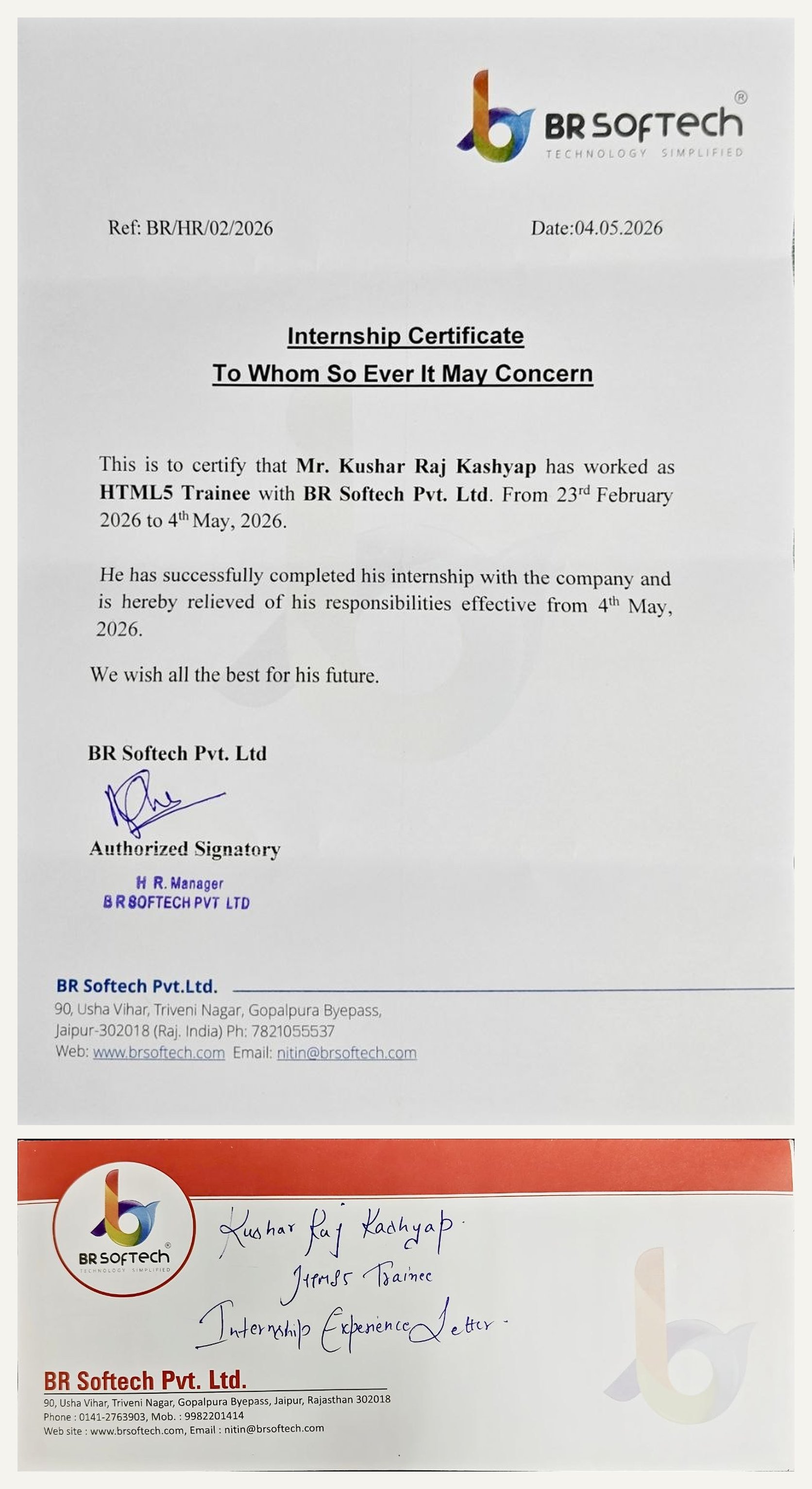
Certifies the HTML5 / Phaser 3 traineeship, 23 Feb – 4 May 2026. Signed by the HR Manager.
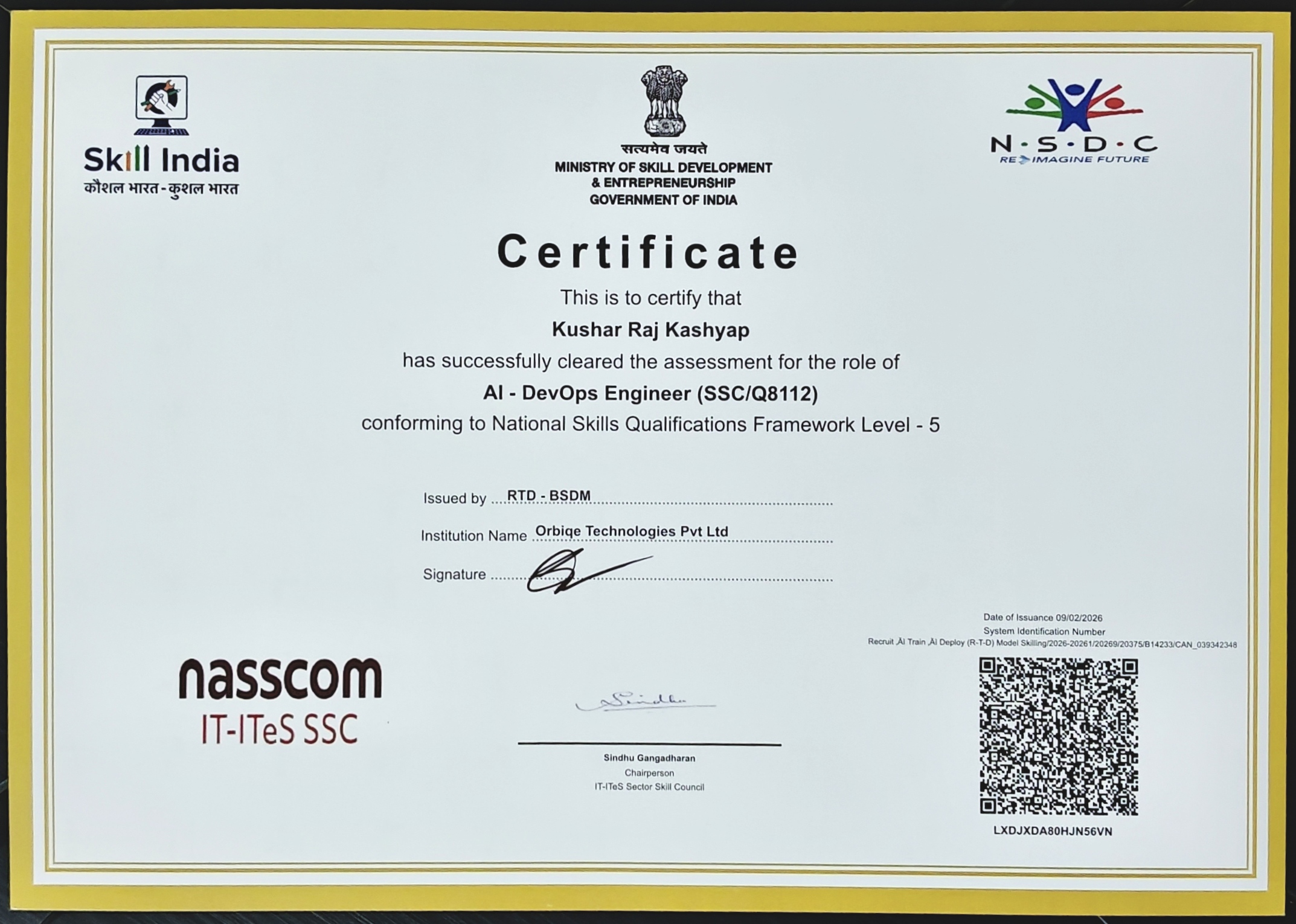
National skills assessment under the IT-ITeS Sector Skill Council, via Orbiqe Technologies.
DevOps practices, CI/CD pipeline design and core AWS DevOps services.
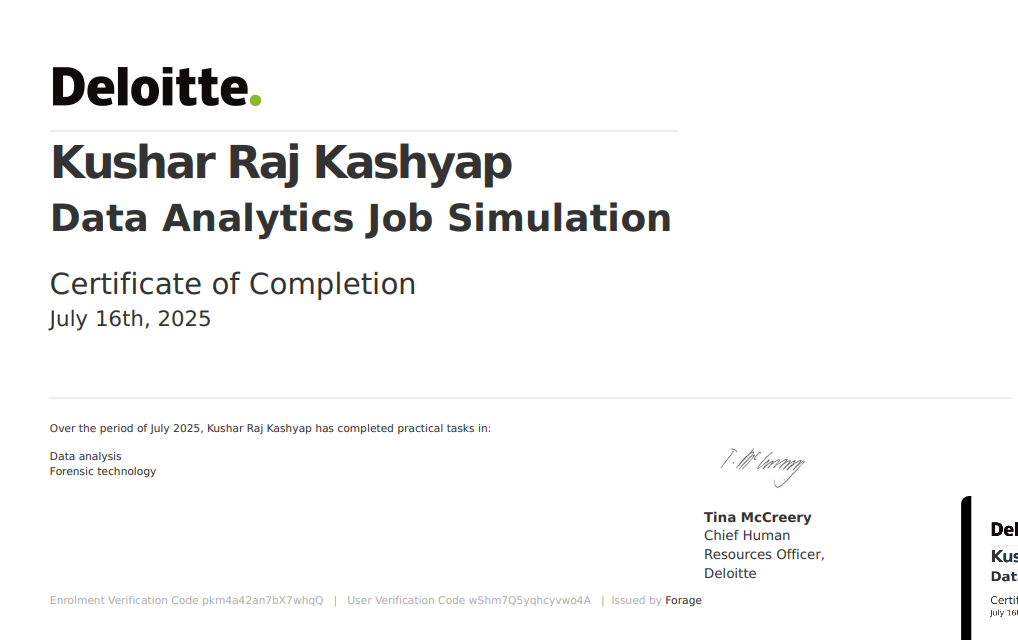
Built a Tableau dashboard, classified data in Excel and practised forensic data review.
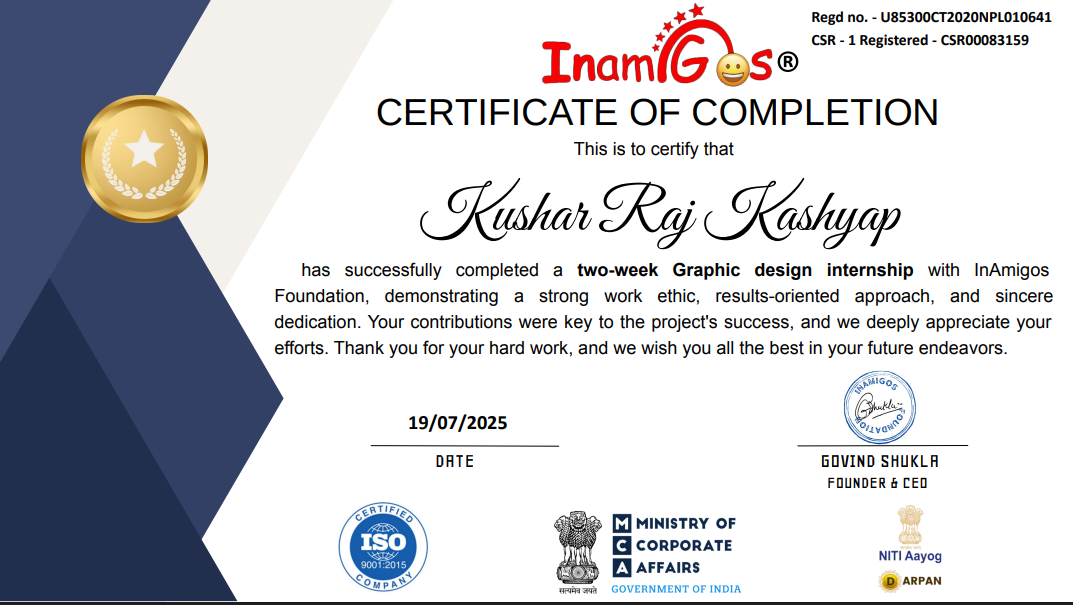
Posters and digital assets for social-impact awareness drives, following brand guidelines.
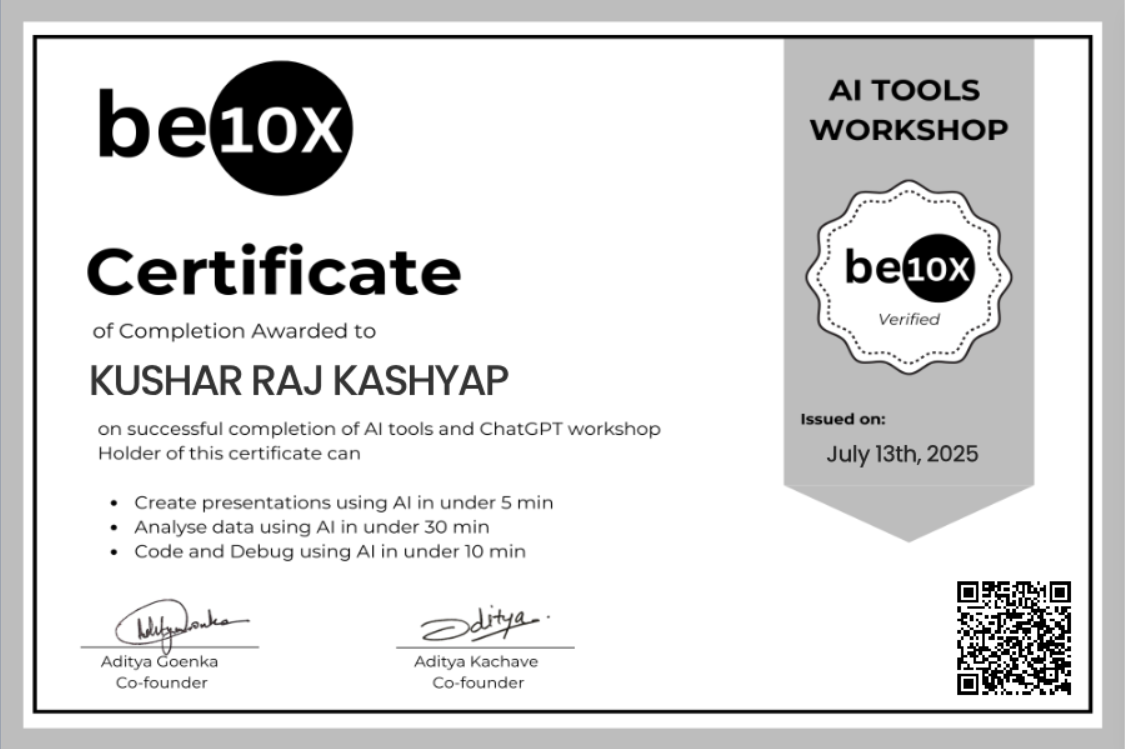
AI tools for productivity, data analysis and AI-paired coding and debugging.
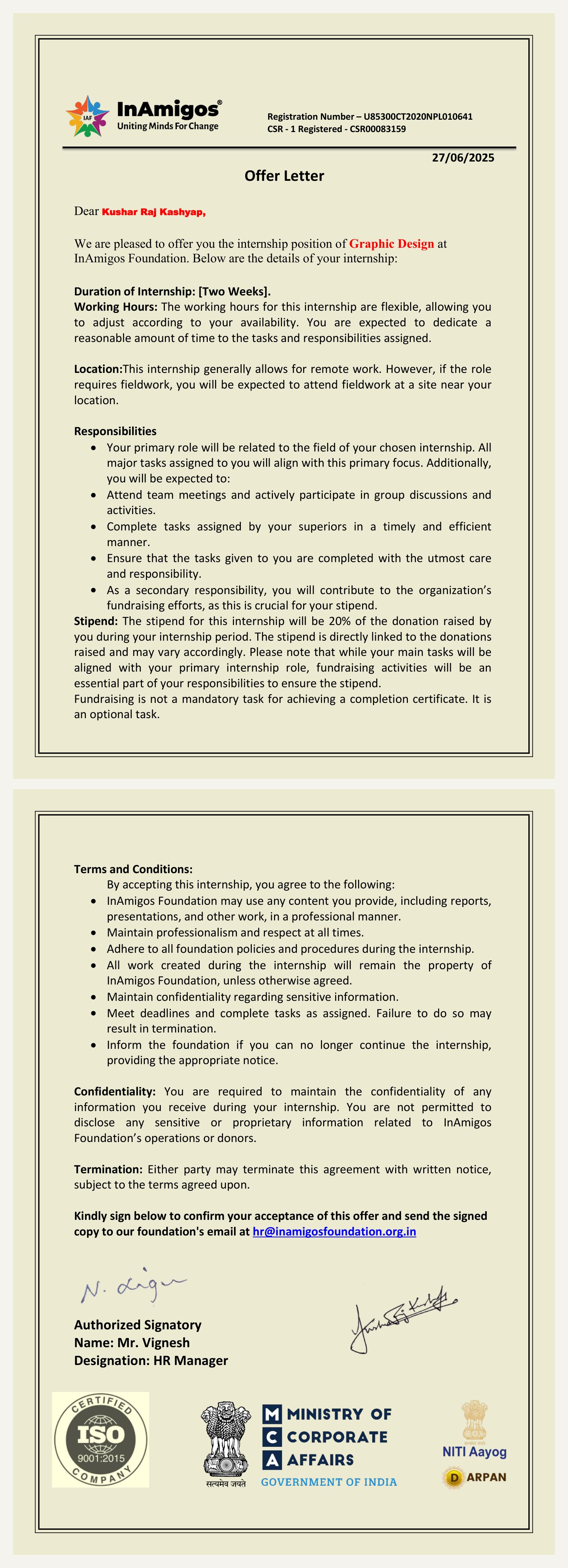
Signed offer for the remote graphic design internship.
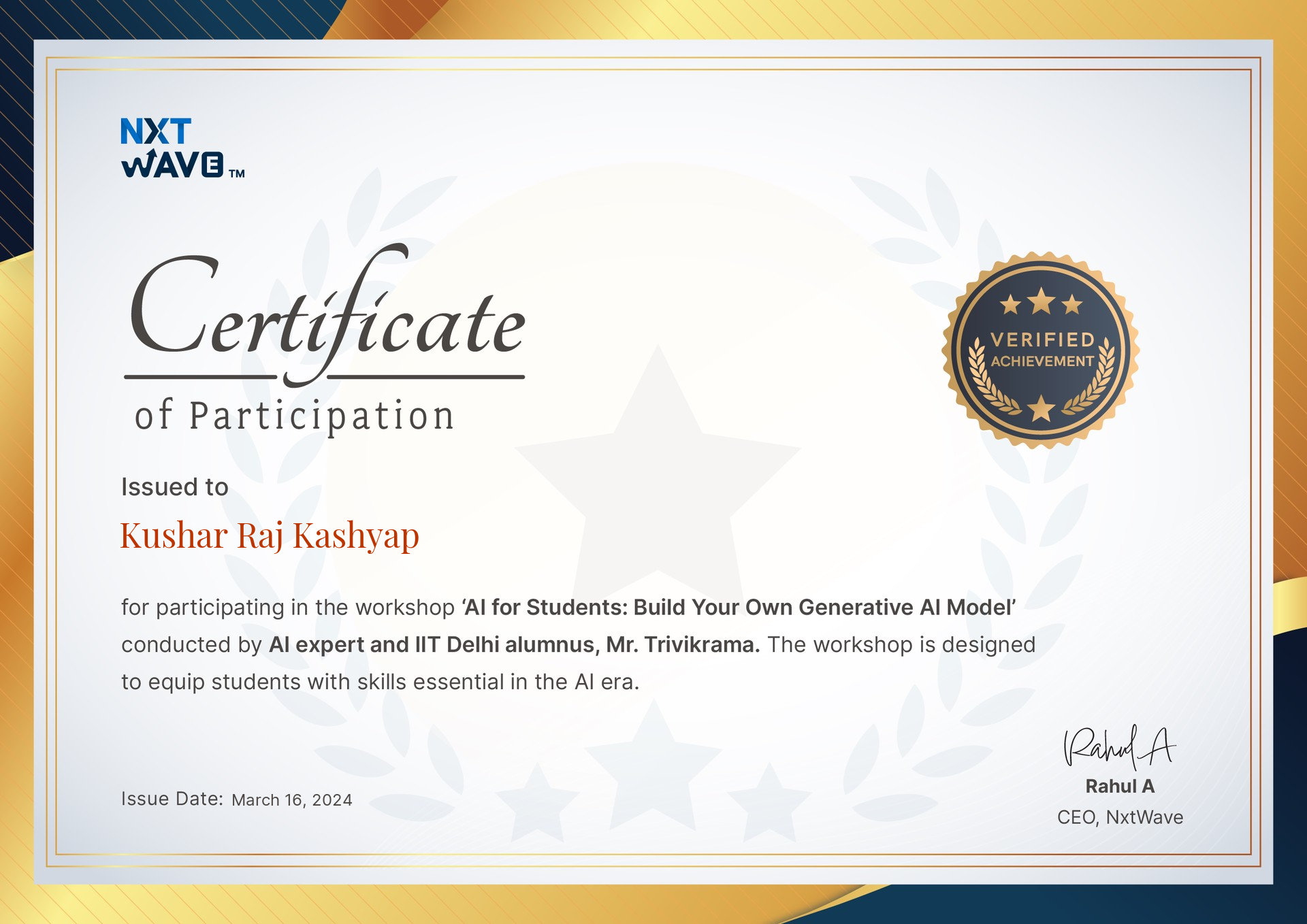
Hands-on workshop: built and trained a generative AI model end-to-end.
Open to full-time roles in Bengaluru or remote. Got a role, a project or a question — send a message. I usually reply within 48 hours.
A chat service that gives each user their own long-term memory. Conversations become durable, searchable facts through Mem0 and Qdrant, while Gemini handles responses and embeddings.
A memory layer an agent can call per user — store facts, update them, delete them, and recall them at chat time.
The request flow: user → FastAPI → retrieve memories → inject into the Gemini prompt → reply → Mem0 updates memory in Qdrant.
/chat and /health with FastAPI.MemoryStore adapter so the memory provider stays replaceable.Wrote pytest tests with fakes — no network needed — covering updates, deletes, duplicates and user isolation.
A tested GenAI memory service with per-user isolation and a swappable memory backend.
A 20-level colour-sorting puzzle game with two modes — unlimited and move-limited — built during my HTML5 Developer traineeship at BR Softech.
A colour-sorting puzzle across 20 levels, with an unlimited mode and a move-limited mode for challenge.
Mapped the game on a tldraw board before coding.
Bundled and optimised game assets with Webpack.
Wrote the game loop in Phaser 3 and JavaScript from scratch, with tap-first input that also works on desktop.
Built the level state machine and win/fail logic for both modes across all 20 levels.
A GitHub Actions workflow auto-deploys every push to GitHub Pages.
A live, playable 20-level game with continuous deployment on every push.
A machine-learning advisor that predicts disaster type and severity, estimates impact and recommends recovery steps — with a relief inventory that warns when stock runs low.
Learn from past disasters to suggest specific recovery steps based on the type and severity of a disaster, and support long-term planning and resource management.
Owned data cleaning on historical, geographic and time-based disaster records.
Trained a Random Forest to predict disaster type and severity, using oversampling to handle class imbalance.

An end-to-end ML pipeline — from cleaned data to predictions, impact estimates, recommendations and inventory alerts.
Browser-native Tetris written in vanilla JavaScript with zero dependencies — piece rotation, line clearing, scoring and game-over detection.
Rebuild the classic mechanics from first principles to sharpen vanilla JS game logic and DOM work.
Diagrammed the game flow on a tldraw board first.
HTML5, CSS3 and plain JavaScript with DOM manipulation — no dependencies.
Piece rotation, line clearing, scoring and game-over detection.
Published on GitHub Pages.
A playable, dependency-free Tetris in the browser.
An HR management system delivered as on-the-job training in the AI-DevOps Engineer program, covering the full DevOps lifecycle.
A Go server containerised with a multi-stage Docker build: the final image contains only the compiled binary, shrinking the image footprint and attack surface compared with a single-stage build.
Pipeline configs, automation scripts and CI/CD setups from real DevOps work.
Jenkins pipeline testing and CI/CD automation configuration.
A code-quality lab integrating SonarQube static analysis with a Node.js project.
A Python microservice architecture — modular, containerised services.
Python scripts exploring Git version-control workflows, automation and branching strategies.
A JavaScript game experiment in mechanics and interactive design — where my game-dev journey started.